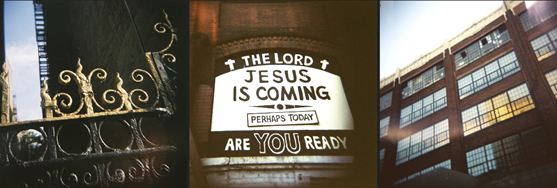
Manhattanville 1
Year: 2008
Medium: 3 pigment prints
Dimensions: 3 x 4 " x 4 "
Evi Abeler
Artist Statement:
Vague Terrain: Manhattanville
In the late 19th and early 20th century, Manhattanville was the site of bustling industrial and commercial activity. Commuters were levitated through Manhattanville via the Broadway elevated subway and the Riverside Drive Viaduct. One hundred and twenty-fifth Street had a port on the Hudson. Two auto assembly plants, the Nash and Studebaker Buildings, were at 133rd and Broadway.
In recent years, Manhattanville’s nondescript gas stations, automotive repair shops, bus depots, store fronts,
and storage facilities have given way to epicurean delights, such as Fairway’s gourmet emporium and a
handful of hip restaurants. The signs of evolution have been eclipsed by the struggle between Columbia
University’s 30-year, multi billion-dollar expansion plan and storage magnate Nick Sprayragen’s refusal
to dislodge his family business, in spite of the threat of eminent domain. Other epoch-shifting forces of
gentrification have left many residents, local business owners, neighborhood preservationists, and community activists apprehensive about their ability to maintain Manhattanville’s character and affordability. These
forces provide the subtext of today’s Manhattanville.
In 2008, Manhattanville is a prime example of a “Vague Terrain,” not only because the place itself is “unsettled,” but because its future is as well. Two opposing visions generally polarize the discussion of vague
spaces in areas such as Manhattanville. The first decries the disorder, decay, and blight they represent in the
city. The second, by contrast, highlights their potential interest as livable spaces where artistic,
religious, and cultural freedoms flourish. Manhattanville is a main area of the changing face of Harlem.